
Year-on-Year Comparison Issue

From West to East: Why Chinese Students Are Choosing Australia and Asia Over the US and UK
For decades, Chinese students have been the bedrock of international higher education enrolments in the United States and the United Kingdom. Prestigious American and British universities reaped the benefits—not only financially, but also in cultural capital and global rankings, by attracting some of the brightest minds from China. But today, that dominance is slipping. A growing number of Chinese students are looking closer to home, choosing Australia and regional hubs across Asia over traditional Western destinations.
The shift is not merely anecdotal. Data from education ministries, migration authorities, and international student agencies points to a sustained decline in Chinese student interest in the US and UK, coupled with rising enrolments in countries like Australia, Singapore, Japan, and even China’s Greater Bay Area. The reasons are manifold: ranging from geopolitical tensions and racism to cost-of-living crises and shifting values among younger Chinese generations.
At the heart of the exodus is a deepening geopolitical chill. U.S.-China relations have been strained for years, but the deterioration accelerated under the previous and present Trump administration. Marco Rubio, the secretary of state, has announced that the authorities will be targeting Chinese students specifically, nationwide. Trade wars, sanctions, and accusations of espionage have all created an environment of suspicion. Chinese students, many of whom are pursuing STEM fields, have found themselves subjected to increased visa scrutiny and academic surveillance. Several high-profile cases of student visa denials or revocations have been widely reported in Chinese media, prompting concern among parents and students alike.
The UK, while more diplomatically neutral, has also seen relations with China sour in recent years. The UK government’s criticism of China’s policies in Hong Kong and Xinjiang, along with its restrictions on Huawei and other Chinese firms, has contributed to a perception that Chinese students may no longer be as welcome as they once were. Add to this the ongoing political instability post-Brexit and growing domestic pressures to cap international student numbers, and it is little wonder why Chinese families are looking elsewhere.
“Why should we spend a fortune sending our children to a country that sees them as a threat?” said Ms. Li, a Beijing-based mother whose son recently enrolled at the University of Sydney instead of his first-choice institution in the US. “In Australia, we feel safer and more respected. And the time zone and food are better, too.”
Safety and cultural comfort are indeed major draws for Australia and Asia. The COVID-19 pandemic, with its racialized narratives and rise in anti-Asian hate crimes in the West, left an indelible mark on Chinese families. In contrast, Australia—despite some rocky diplomatic moments with Beijing—has worked hard to rebuild trust. The re-election of a more moderate government and a push to re-engage with Asia have gone some way toward reassuring Chinese students and their families.
Moreover, Australia offers a key advantage that neither the UK nor the US can currently match: clear post-study work pathways. Graduates from Australian universities can often stay in the country for two to four years after finishing their degrees, and in certain regions, they may be eligible for permanent residency. The UK’s Graduate Route two-year post-study visa is now due to be reduced to just 18months following the UK’s Immigration White Paper, and other restrictions are tightening. The US, meanwhile, remains bogged down in its convoluted H-1B visa system, which leaves many international students uncertain about their futures.
In contrast, Singapore and Japan offer high-quality education, safety, and increasingly competitive employment prospects—especially in finance, technology, and innovation sectors that align with China’s own economic goals. Singapore’s bilingual environment and reputation for academic excellence make it a particularly attractive choice for Chinese families seeking both Western-style education and Asian values.
The rise of intra-Asian mobility is also being driven by generational change. Today’s Chinese students are more global in mindset but also more pragmatic. Prestige still matters, but practical outcomes matter more. An education that leads to employability, residency, or entrepreneurial opportunities is now more valued than one that simply offers a famous name. In many Asian countries, students are able to build professional networks, gain regional work experience, and stay closer to family—all without the alienation or uncertainty of life in the West.
Cost is another factor tipping the scales. With inflation and living costs soaring in the UK and US, studying in those countries is becoming prohibitively expensive, especially for middle-class families not eligible for top scholarships. Tuition fees in Australia and Asia are generally lower, and daily expenses, from housing to food, are significantly more manageable. For families making careful financial decisions in a post-pandemic, post-property-boom China, value for money is essential.
Then there’s the rise of China’s own regional education ambitions. The Greater Bay Area initiative, which aims to integrate cities like Shenzhen, Guangzhou, and Hong Kong into a global innovation hub, is investing heavily in education. New joint universities, research centres, and cross-border programs are making it more appealing for top-tier Chinese students to stay within the region. Hong Kong’s universities, which offer instruction in English and have global recognition, are also drawing students who once might have gone to London or New York.
All of these shifts are being felt acutely by universities in the West. For many, Chinese students made up the largest share of international enrolments and a significant revenue stream. The drop in applications and enrolments from China has forced institutions to rethink recruitment strategies and diversify their international student base. But some in the sector argue that Western governments have been slow to understand the implications of losing Chinese talent.
“Chinese students have choices now. They no longer need to tolerate being seen as cash cows or security threats,” said Professor Rachel Tan, a higher education researcher based in Hong Kong. “Western universities need to understand that prestige alone doesn’t cut it anymore. Students want respect, opportunity, and a sense of belonging.”
The long-term implications of this eastward shift are profound. As China’s influence grows and Asian universities climb global rankings, we may see a rebalancing of academic power. International education, once dominated by a Western-centric model, is becoming truly multipolar. For China’s students, that means more choices, more agencies, and less need to chase validation from foreign institutions.
But it also signals a need for introspection in the US and UK. To regain trust, they must go beyond marketing campaigns and scholarships. They must tackle xenophobia, simplify immigration rules, and demonstrate that Chinese students are not just welcome, but valued.
Chinese students’ pivot toward Australia and Asia is not just a reaction to geopolitics or economics. It is part of a broader rethinking of what global education means in a more interconnected, less Western-dominated world. While the US and UK still hold appeal, their failure to adapt to the expectations of a new generation is costing them dearly.
The East is rising—not just economically, but academically. And China’s students are leading the way.

Graduate Outcomes: Australia vs UK
Each year we take a closer look at how international graduates from Australian and UK universities fare once they graduate and return home. Graduate outcomes remain one of the strongest indicators of how attractive a study destination is, not only for prospective students but also for employers, governments, and policymakers. Questions around how quickly graduates secure their first role, which institutions give them the strongest advantage, and how they are received by employers in different countries all shed light on the shifting dynamics of international education.
With updated data now available, it’s possible to compare today’s results with last year’s findings and see where the trends are moving. Some patterns have held steady, but there are also important changes emerging that may shape how both countries, Australia and the UK, position themselves in the competition for international students.
1. Do graduates from Australia or the UK find jobs more quickly back home?
Australia vs UK
 |
 |
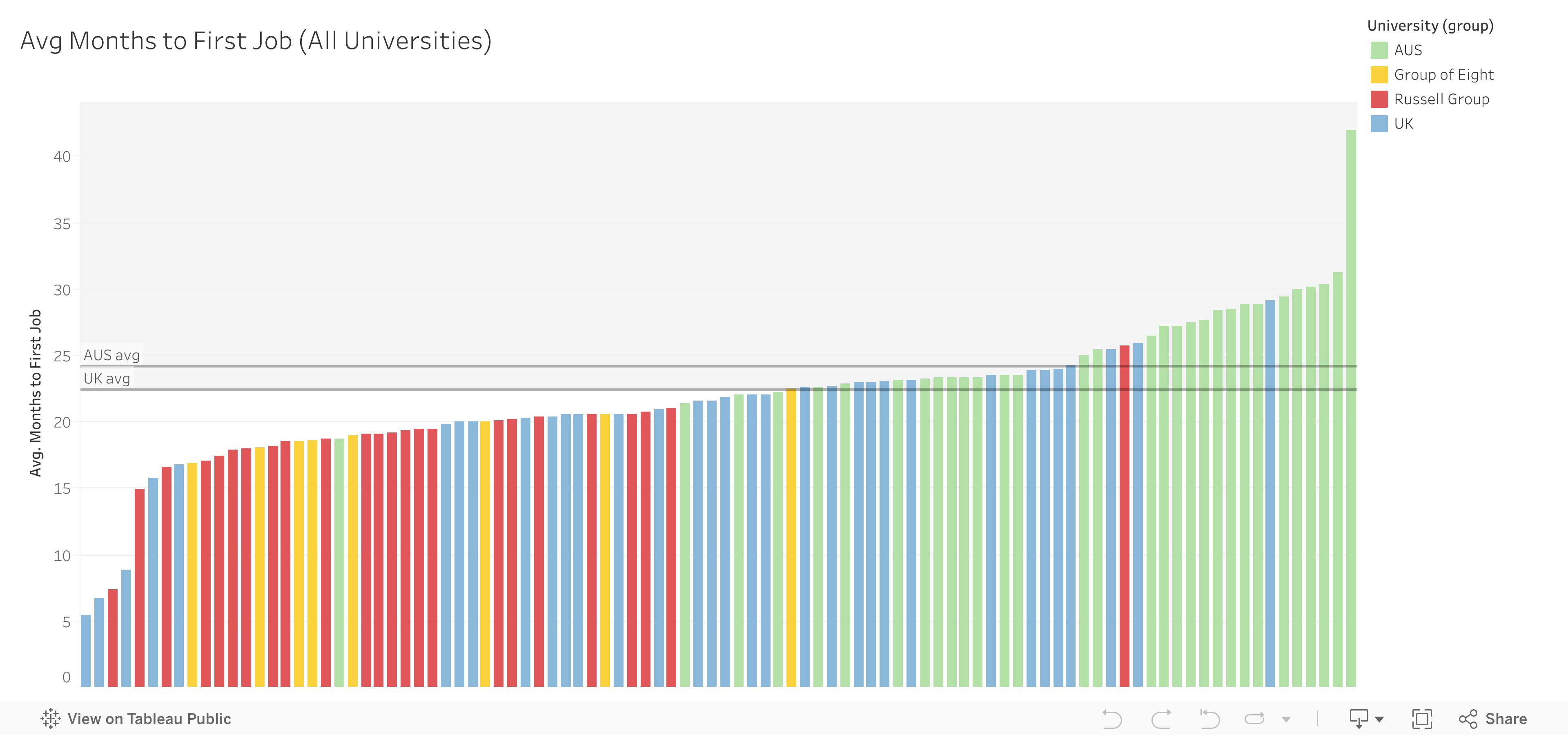
This year’s findings point clearly in the UK’s favour. International graduates from UK universities are now securing their first job back home in just over 20 months on average, an improvement on last year’s results. By contrast, graduates from Australian universities are taking longer than before, stretching out to 27 months on average. What was once a modest two-month advantage for the UK has grown into a gap of more than six months.
The picture is even sharper when we break it down by nationality. Chinese graduates from UK universities return home and find work four months faster than their peers from Australia. For Hong Kong graduates the difference is six months, Malaysians six and a half, Singaporeans around two to three, and for Thai graduates the gap widens to almost ten months.
There are exceptions. Among Filipino graduates, those from Australian universities find work in under a month on average, compared to over 11 months for their peers from UK institutions. This figure, however, should be treated with caution — Australia’s sample size is very small for this group, while the UK sample is broader and drawn from more universities.
While the data paints a clear picture: UK graduates returning home are securing jobs more quickly than their Australian counterparts—recent developments in UK visa policy could influence what lies ahead. The government’s May 2025 Immigration White Paper proposes trimming the Graduate Route’s stay-from-two-years down to 18 months. For now, this remains a proposal and has not yet been enacted into law.
If implemented, this shorter post-study work window could put pressure on international students to find skilled employment more quickly, or move into a sponsored work visa sooner. While potentially helping the UK meet its migration and economic objectives, such a change might also impact how attractive the UK appears to international students—especially when weighed against countries like Australia, where post-study work remains more generous, despite recent spikes in visa charges.
Russell Group vs Group of Eight
 |
 |
Looking at Russell Group(RG) and the Group of Eight(Go8) specifically: last year, Go8 graduates found jobs about a month faster than their Russell Group peers, and this year the margin is almost the same. Go8 graduates are now averaging 19.86 months, compared with 20.78 months for Russell Group graduates — a difference of less than a month.
What has shifted are the nationality-level patterns. For Chinese and Malaysian graduates, the Russell Group disadvantage has grown: from 1.2 months and 0.08 months slower last year, to 1.5 months slower in both cases this year. For Sri Lankan graduates, the gap has narrowed slightly, from more than 8 months last year to around 7.5 months now.
The conclusion remains consistent: Go8 graduates reach their first job back home a little more quickly than Russell Group graduates, but the gap is small. The more noticeable shifts likely reflect graduates’ home markets, where job conditions create clearer differences by country.
<This Year’s>

The graph above provides an overall visual summary of the results. In the UK, the shift comes from more non-Russell universities appearing at the faster end, while several Russell Group institutions have moved further back. In Australia, the higher overall average is largely driven by slower-performing universities taking longer to place graduates, rather than changes among the leading institutions. Together, these shifts underline how group-level averages can mask important differences at the institutional level.
<Last Year’s> - For reference, last year’s graph is included below.
2. Which graduates are more employable when they return home, Russell Group or The Group of Eight graduates?
While the UK currently has the edge in terms of how quickly graduates secure their first job, Australia continues to lead when it comes to overall employability. This year’s data shows that 83.16% of international graduates from Australian universities are employed, compared to 78.90% of their peers from the UK. The margin is almost identical to last year’s figures, underscoring a consistent gap in Australia’s favour.

Australia vs UK
 |
 |
Looking more closely at the country-level results, the overall picture becomes more nuanced. For example, Filipino graduates show one of the sharpest contrasts: in Australia their employability rate dropped to just 63.6%, while in the UK it reached 83.6%. By contrast, Pakistan and Sri Lanka show differently, with UK graduates posting higher rates than their Australian peers in both years, with the gaps increased slightly this year.
On the Australian side, Singapore and Indonesia continue to perform strongly, maintaining consistently high employability above 85%, in line with last year’s trend. Meanwhile, Nepalese graduates show a notable divergence, with higher employability in the UK (81.9%) compared to Australia (74.7%), a gap that also widened from the previous year. These variations suggest that while Australia maintains an aggregate advantage, outcomes differ significantly by nationality and shift subtly year on year.
These differences likely reflect more than just university reputation. Home-country labour markets, existing diaspora networks, and employer familiarity with certain institutions all play a role. For instance, Nepalese and Filipino graduates seem to benefit more from a UK degree when returning home, while Singaporean and Indonesian graduates show stronger outcomes from Australia. Such patterns suggest that employability is not simply about where one studies, but how well that degree is recognised and connected to opportunities in the graduate’s home market.
Russell Group vs Group of Eight
 |
 |
Among prestigious universities such as the Group of Eight or Russell Group members, they fare pretty similar to the overall trend: Go8 graduates show stronger employability outcomes than their Russell Group peers. This year, Go8 graduates report an employability rate of 82.37%, compared to 78.96% for the Russell Group—a gap very similar to last year’s (82.36% vs. 79.46%).
At the country level, Chinese graduates from the Go8 improved slightly on last year, while their Russell Group peers declined, widening the gap between the two groups. Indian graduates recorded lower employability in both systems compared to last year, but the decline was sharper for the Russell Group. Malaysian graduates also saw a fall in both systems, with a smaller drop for the Russell Group, reducing the gap slightly.
Singapore is notable for maintaining very high employability in both groups, with the Go8 at 86.91% and the Russell Group at 83.47%. The gap has remained steady, confirming the consistently strong outcomes of Singaporean graduates. Conversely, Pakistan, Sri Lanka, and Bangladesh graduates lean towards the Russell Group, though the margins are smaller and more variable.
The numbers show that Australia’s advantage in employability is not just structural, but reinforced at the level of its most prestigious universities. Still, the country-level shifts remind us that international graduate outcomes remain highly context-dependent, shaped as much by recognition in home markets as by institutional brand.
More can also be done in both countries to support international graduates as they transition into the workforce back home. Universities should take these differences into account when supporting their graduates’ career transitions. For example, targeted employer engagement in key source countries would help strengthen recognition of qualifications and improve outcomes for nationalities where gaps remain. Equally, showcasing strong results in markets such as Singapore and Indonesia could be a valuable part of international recruitment strategies. By aligning institutional outreach with labour market realities in students’ home countries, universities can extend their reputational strength into tangible career outcomes for their graduates.
<This Year’s>

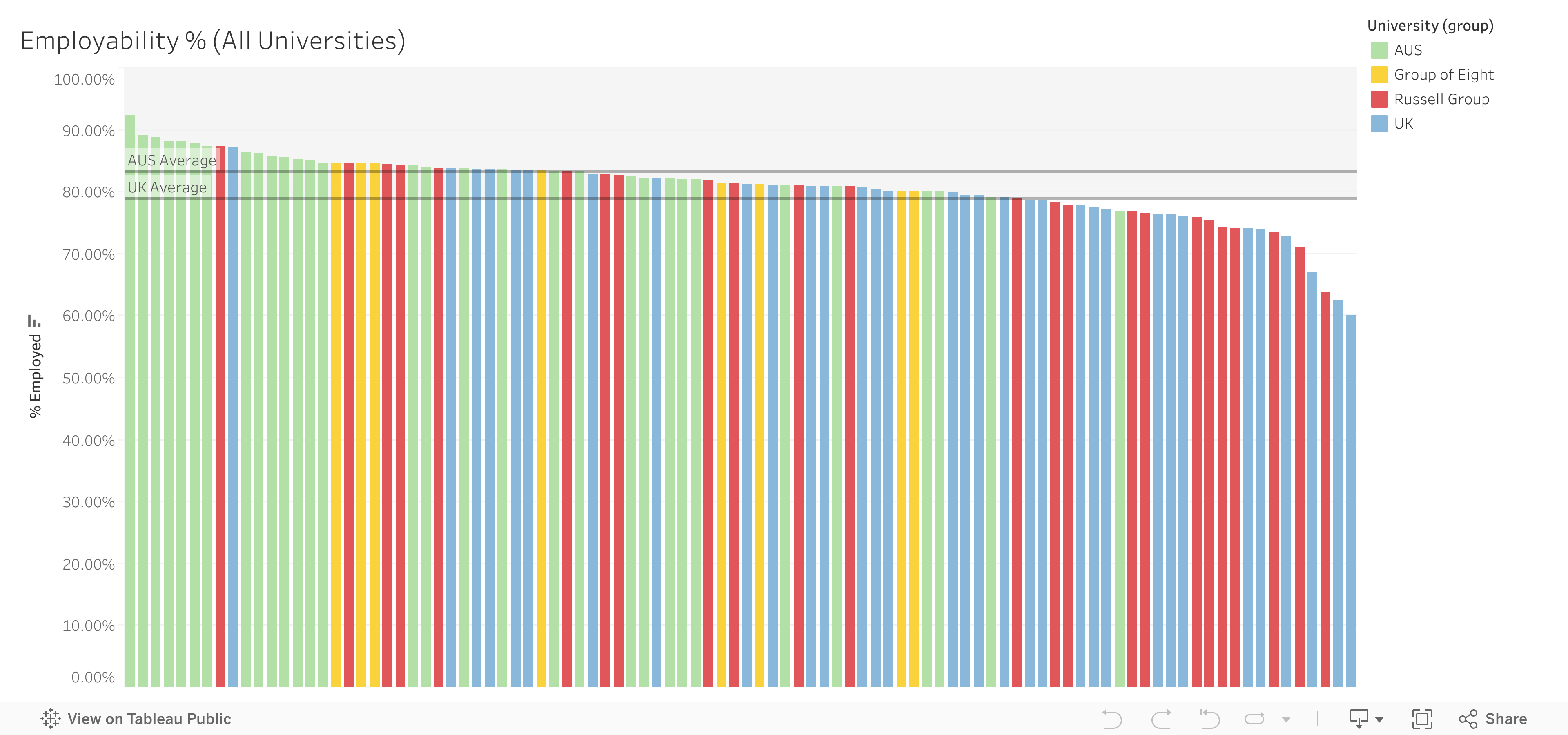
From the graph above—which provides an overview of graduate employability across institutions—three more universities have moved forward in their rankings compared to last year. Last year’s top performer hit 92.31% employability (an Australian university), and the lowest was 60.08% (a UK university). This year, the top is 90.24% (also Australia), and the lowest 63.55% (UK). Encouragingly, about 75% of institutions now lie above the UK average, even in a challenging hiring market.
That said, universities should proactively support their fresh graduates during this uncertain time, helping them establish the foundations needed to stabilise their job search. The graduate job market remains tough, and stronger institutional involvement through structured career support, closer engagement with employers, and timely guidance for international graduates returning home can make a real difference. At the same time, showcasing strong results in markets such as Singapore and other countries where their graduates excel could further enhance each university’s global positioning.
<Last Year’s> - For reference, last year’s graph is included below.
3. Who are the top employers of Australian & UK graduates, when they return to their home countries?
 |
 |
This year’s top employers of international graduates show remarkable stability, with the same ten firms appearing across both Australia and the UK as last year. While their exact positions have shifted slightly, the fact that no new entrants have broken into the top ranks highlights how entrenched these companies are in attracting graduate talent from both systems.
What stands out is that, even with a much smaller graduate pool (around 30,000 compared to 65,000 in the UK), Australian universities continue to channel a significant share of their graduates into leading firms. This higher concentration is partly a function of scale but also reflects the strong employer engagement and regional proximity that Australian institutions have cultivated, particularly in Asia where firms like Shopee, DBS, and Standard Chartered remain prominent.
For both Australia and the UK, the lesson is clear: sustained engagement with global employers is essential to ensure graduates can compete in an increasingly tough job market. By strengthening these ties and showcasing their graduates’ success in securing roles at leading firms, universities can reinforce both employability outcomes and their own global reputations.

Is the UK just the least bad option?
With record numbers of international students applying to UK universities in early 2025, many in the sector are breathing a cautious sigh of relief. Despite mounting concerns over net migration figures, looming visa reforms, and the ripple effects of an increasingly fraught geopolitical landscape, international demand appears resilient. Yet this surge raises an important question: where is the growth coming from—and how sustainable is it?
According to data released by Enroly in Q1 2025, UK universities have seen a marked increase in international student deposits and Confirmation of Acceptance for Studies (CAS) issuance, particularly from key markets like India, Nigeria, and Pakistan. Meanwhile, ApplyBoard data points to an 8% decline in applicants from China—a significant shift, considering that China has historically been the single largest source of international students in the UK (ApplyBoard, 2025).
This dip in Chinese interest is not just a statistical blip. It reflects growing tensions between China and Western countries, a shift in domestic policy that favours keeping talent at home, and an increasing preference for destinations perceived as more welcoming or economically aligned (ICEF Monitor, 2024). With Trump’s return to the White House and tightened immigration rules in Canada and Australia, the UK seems to be absorbing some of the demand displaced from these increasingly hostile or uncertain destinations.
So, is the UK experiencing a golden era of global student recruitment, or simply benefiting from being the least bad option?
There’s a case to be made for both. The UK does boast globally ranked institutions, a relatively streamlined visa system (for now), and the two-year Graduate Route, which allows international students to remain in the UK post-graduation to find work. But at the same time, the underlying factors behind recent growth appear to hinge far more on the comparative decline of competitors than on a coherent national strategy.
Australia has faced backlash over fluctuating visa rules and high living costs (The PIE News, 2024), while Canada has imposed caps on international enrolment in several provinces and is increasingly restricting post-study work rights (Times Higher Education, 2024). Meanwhile, the US continues to suffer from safety concerns, cost barriers, and restrictive work opportunities for international graduates. By contrast, the UK has so far maintained relatively liberal policies, making it the "least complicated" option among the big four destinations.
However, this position may be under threat. The UK government’s Immigration White Paper proposes tightening the eligibility of dependants, revising Graduate Route provisions, and potentially implementing a £6,000 international student levy (UK Home Office, 2024). While none of these measures are yet in force, they signal a shifting political mood. With net migration still politically toxic: about 745,000 in 2022 according to the Office for National Statistics (ONS, 2023), international students remain a tempting lever for ministers seeking to make symbolic cuts.
The sector's reliance on international fee income—now estimated at over £9 billion annually (Universities UK International, 2024)—makes it particularly vulnerable to even modest changes in visa policy or sentiment. Universities have become increasingly dependent on these students to offset declining domestic per-student funding. As noted by the Migration Advisory Committee (2024), this model is "reaching its limits."
So how can the UK insulate itself against these risks and maintain international appeal in an increasingly competitive and volatile market?
The answer lies in differentiation. While much effort has been placed into geographic diversification such as targeting new markets in South Asia, Africa, and Latin America, there has been far less emphasis on what truly matters to students: outcomes. According to IDP's Emerging Futures 7 report, the number one driver of international student decision-making is the employability benefits of studying abroad (IDP, 2024).
Yet UK institutions remain behind their peers in integrating employability into international recruitment messaging or post-study support. Too often, career services are domestic-facing, alumni networks underdeveloped, and international labour market outcomes poorly understood or tracked. While the government has highlighted the importance of employability, for example, in a 2019 letter from the then Caretaker Secretary of State to the Office for Students (OfS)—this has yet to translate into sector-wide action. The OfS was urged to ensure that international students are well-supported in terms of mental health, integration, and career readiness, both in the UK and their home countries. It was even suggested that universities should publish transparent graduate outcomes data for their international cohorts. Yet, despite such data being available via platforms like Asia Careers Group since 2019, few universities have chosen to engage.
This disconnect may soon come at a cost. If international students do not see a clear pathway to employment, either in the UK or back home, the UK’s edge over its global rivals may erode quickly. Just as Australia and Canada experienced dramatic shifts in enrolment after policy changes, so too could the UK.
In truth, the UK’s current growth in international student numbers is less a product of deliberate strategic excellence than it is the result of capitalising on the misfortunes and missteps of other nations. Visa clampdowns in Australia and Canada, along with rising safety concerns and political uncertainty in the US, have nudged more students toward the UK, more by default than design. While universities have undoubtedly improved outreach in some emerging markets, calling this a “smart recruitment strategy” overstates the level of coordination and long-term planning involved.
If the UK is serious about maintaining and justifying its position in global higher education, it must move beyond passive advantage and toward genuine differentiation. As previously noted, international students are increasingly focused on long-term outcomes, particularly career advancement, whether it be in their home countries or abroad. If the UK wants to insulate itself from future government policy shocks and remain resilient amid growing global competition, then a clear answer to the question “What do UK degrees lead to?” is essential.
That means putting international graduate employability front and centre. UK institutions should systematically support students’ transition into careers back home through tailored careers services, employer connections, alumni networks, and transparent outcome data. It also means lobbying for immigration policies that enable real-world experience during or after study, while pushing for longer-term investment in transnational education and reciprocal recognition agreements.
In a volatile and politically sensitive space, future-proofing is less about weathering each storm than it is about building a ship that can sail through them with purpose. The UK cannot rely forever on being the least bad option. It must give international students a compelling reason to choose it—not just because others are worse, but because the UK is uniquely good at helping them succeed.
References:
- ApplyBoard. (2025). Global Student Mobility Trends Q1 2025.
- ICEF Monitor. (2024). China's shifting outbound student trends.
- The PIE News. (2024). Australia’s international education policy upheaval.
- Times Higher Education. (2024). Canada’s cap on international students sparks concern.
- UK Home Office. (2024). Immigration White Paper.
- Office for National Statistics (ONS). (2023). Migration Statistics Quarterly Report.
- Universities UK International. (2024). The role of international students in UK higher education.
- Migration Advisory Committee. (2024). Review of the Graduate Route.
- IDP. (2024). Emerging Futures 7: International Student Decision-Making Trends.
- Asia Careers Group. (2019). International Graduate Outcomes Data.


